What Your Land Budget Actually Buys in Lee County: A Zone-by-Zone Read
A buyer called last spring with $400,000 and a printout of Lee County land comps. On paper, the math looked clean. The county's active listings average somewhere between $35,000 and $40,000 per acre, so ten acres seemed like the ceiling. Two afternoons of driving showed how misleading that arithmetic is. A 38-acre tract on Tramway Road with 1,800 feet of frontage was priced as raw development. A 43-acre parcel off South Plank Road with municipal water at the road was priced as timber and pasture. A three-acre cutout on Deep River Road was priced per lot, not per acre. Same county. Same month. Three different markets.
The median price per acre in Lee County is a fiction. The same dollar figure buys three fundamentally different assets depending on which side of the Sanford ETJ line it sits on, and industrial capital is widening that gap faster than the comp sheets can track.
Lee is a small county, 259 square miles, split between Piedmont in the north and Sandhills in the south, bordered by Chatham, Harnett, and Moore. Inside those 259 square miles, the land market behaves as if it were three separate counties stitched together. If a buyer treats Lee as a single average, they will either overpay for dirt that will never see sewer or walk away from acreage that is quietly repricing every quarter.
This is the zone doing the heaviest lifting on the county's per-acre average. A 95-acre assemblage along Hwy 421 sits inside the Sanford growth corridor. A 45-acre three-parcel assemblage on O'Quinn Road and Brookcliff Drive falls inside Sanford's Extraterritorial Jurisdiction and carries Suburban Neighborhood SN-9 zoning, which is a residential-density classification, not agricultural. A 140-acre tract just outside city limits off Valley Road has been priced at roughly $25,000 per acre with the understanding that it will annex once sewer and a lift station are worked out with the city.
The pricing signal inside the ETJ is not about the current use of the land. It is about the option value on future annexation, water and sewer extension, and a rezoning to something denser. A buyer paying corridor prices for a hobby farm here is paying for entitlements they will never exercise.
Move west of downtown Sanford, past the industrial parks, and the market shifts. A 43-acre tract on South Plank Road in northwestern Lee sits in what the listing agents call "the rural area of western Lee County," yet still has county water at the road and fiber optic cable. That combination, road frontage plus utility proximity plus rolling topography, is the classic small-farm buy in Lee County. Prices per acre run well below the corridor numbers, but the buildable envelope is real and the septic pathway is usually straightforward on Piedmont clays.
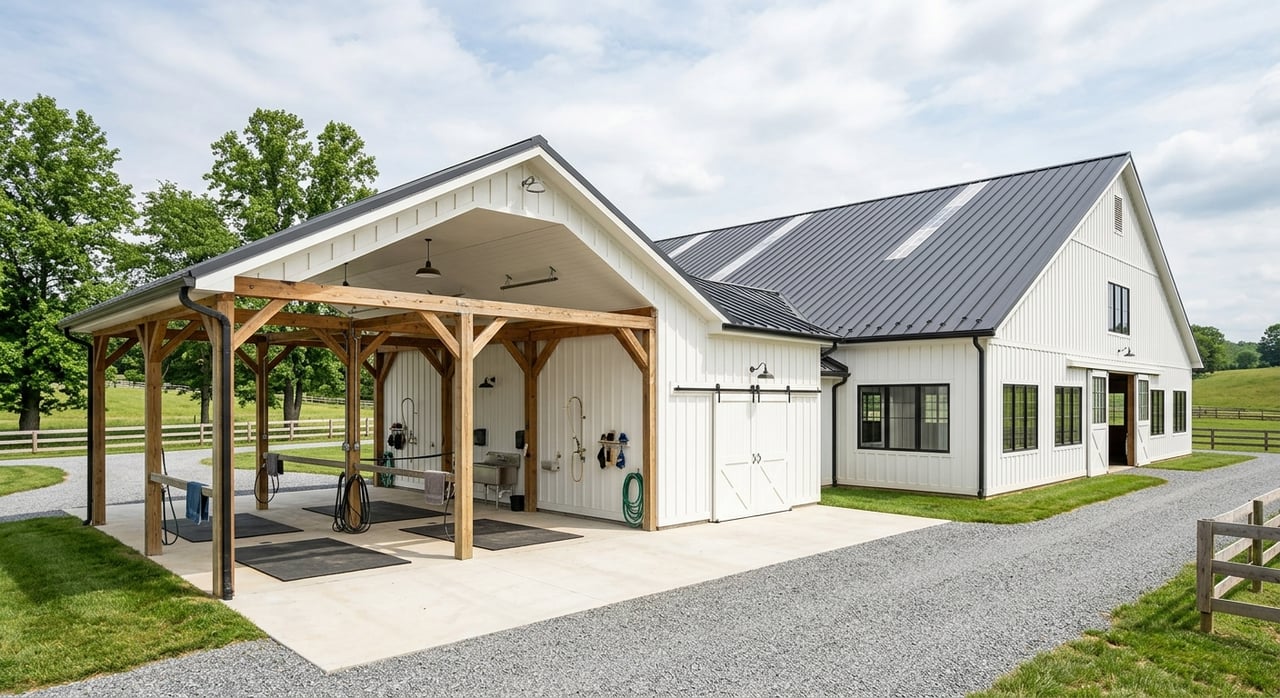
This is where the Legacy Farms audience actually transacts. Hobby farms, equestrian setups, timber tracts with hardwood and pine mix, and small acreage country homes cluster here because zoning stays Residential Agricultural, the road grid supports trailers, and Central Carolina Community College and Sanford services are still inside a fifteen-minute drive.
South of Sanford the soils change, the pine stands thicken, and the recreational buyer takes over. A 12.61-acre timber tract near Sanford was recently marketed on its hardwood-and-pine mix and wildlife activity rather than any development story. A 15-acre tract on the Cape Fear River sits mostly inside floodplain, with only about 0.45 acres out of the flood zone where a home site can actually be cleared and perc-tested. On paper that parcel looks like a bargain per acre. In practice, the buyer is paying for a food plot, a river access easement, and a single approved building envelope.
Lee County has been running a decade-long industrial recruitment campaign that most Triangle land buyers still price into their offers incorrectly. The Sanford Area Growth Alliance's 2024 retreat report described Bharat Forge as completing a second facility with roughly 200 additional jobs, with third and fourth phases in discussion. Kyowa Kirin selected Helix Innovation Park at the Brickyard for a new biomanufacturing site, a $520 million investment expected to bring 102 jobs. Astellas Gene Therapies, based in the Central Carolina Enterprise Park, is advancing an expansion. Pfizer's Sanford campus, on 230 acres just south of the Research Triangle, is one of the largest U.S. biotechnology hubs, with vaccine and gene therapy capabilities. Caterpillar has expanded through its acquisition of the former GKN Driveline building, extending a 26-year presence in Sanford. Add VinFast's Chatham County plant roughly 25 miles northeast, and the wage base pulling into Lee is not the Lee wage base of 2015.
The knock-on effect is uneven. Corridor land closer to the industrial spine reprices on entitlement optionality. Western Lee reprices more slowly, on residential end-user demand from workers who want acreage but not a subdivision lot. The Sandhills south reprices barely at all on jobs, and mostly on recreational demand from Fort Liberty and southern Wake.
| Zone | What the dollar buys | What drives the price |
|---|---|---|
| Sanford ETJ / US-1 / 421 corridor | Entitlement option, future annexation, dense residential zoning like SN-9 | Utility extension, industrial job announcements, DOT access |
| Western agricultural belt | Working acreage with buildable envelope, county water, fiber | End-user residential demand, road frontage, perc results |
| Sandhills south and river frontage | Timber, hunting, recreational tract, single home site | Timber stand age, floodplain footprint, wildlife use |
The friction points that catch out-of-market buyers in Lee are not the ones the listing sheet advertises. They surface in the file review, and they are consistent enough to plan for.
The practical read for a $300,000 to $600,000 land budget in Lee County is that the buyer is choosing between two categories of asset, not between two prices per acre. Corridor land at Zone 1 pricing is a bet on Sanford's industrial trajectory and eventual annexation, and it should be underwritten like a development deal, not like a farm. Western Lee land at Zone 2 pricing is a bet on the buyer's own use of the property, and it should be underwritten on perc, frontage, and utility distance. Sandhills and river frontage at Zone 3 pricing is a recreational or timber asset with a defined home site, and it should be underwritten on the upland pad and the stand age.
The average $35,000 to $40,000 per acre number that appears across the land marketplaces conflates all three. It is useful for benchmarking a single county against Chatham or Moore. It is not useful for pricing a specific tract inside Lee.
Does the Sanford industrial expansion affect western Lee land prices? Indirectly. The direct pricing pressure lands on the corridor tracts closer to the industrial parks and along US-1 and Hwy 421. Western Lee benefits on the residential end-user side as workers seek small acreage within a fifteen- to twenty-minute drive of the plants, but the acre-level premium is much smaller than in the ETJ.
Is a parcel inside Sanford's ETJ subject to city property tax? Not automatically. ETJ status places a parcel under city planning and zoning authority while it remains outside city limits for tax purposes until annexation occurs. Confirm current tax jurisdiction with the Lee County Tax Office and current planning jurisdiction with the City of Sanford before writing an offer.
How should a buyer treat a Cape Fear or Deep River tract with most of its acreage in floodplain? Price the upland pad, the access easement, and the recreational use separately, then add them. A floodplain acre is not worthless, but it is not a building acre either, and treating the whole parcel at a blended per-acre rate almost always overprices it.
Lee County rewards buyers who read the map at zone resolution rather than county resolution. If you are weighing a specific tract and want a plain read on where it sits inside these three markets, the team at Legacy Farms & Ranches of North Carolina will walk the property with you, pull the zoning and floodplain overlays, and tell you which category the dirt actually belongs to before you sign anything. Talk to a Land Specialist.
If you have a unique country home, hunting or fishing land, or other premier North Carolina property for sale, call Legacy Farms and Ranches today to learn how they can help you market your property to thousands of discerning viewers across the country.
Get In Touch With Our Team To Learn More About Our Services! Although the disclaimer is below, we will only put you on our Newsletter Mailing List!
Legacy Farms and Ranches of FM Realty
7980 Arco Corporate Dr Ste 105 Raleigh NC 27617